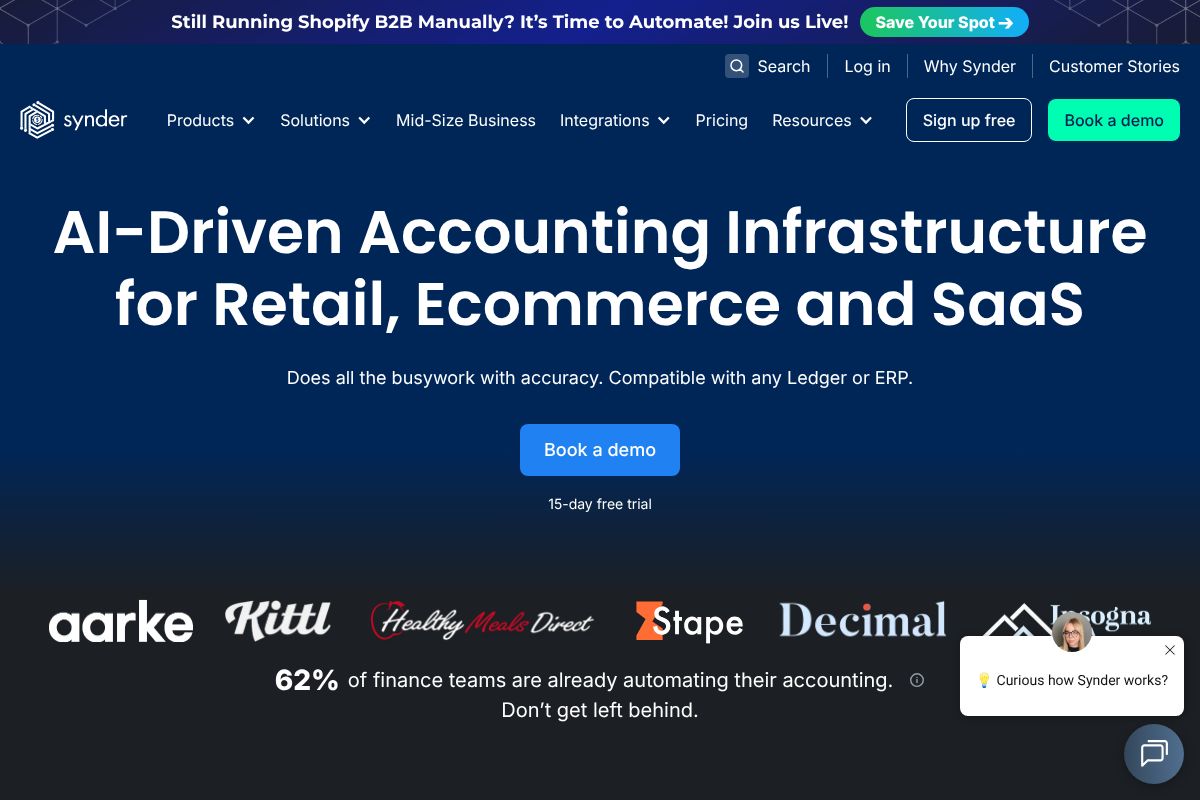
How Synder Works
Synder connects directly to sales platforms, payment processors, and your accounting system, then maps incoming transactions to ledger accounts according to configurable rules. Data flows from sources such as Shopify, Stripe, Amazon, Square, and PayPal into a Synder staging area where AI-driven categorization and custom mapping apply before posting to the ledger.
A typical workflow is: connect a sales channel, configure mapping and categorization rules, review matched deposits and automated reconciliation suggestions, and then publish validated journal entries into QuickBooks or Xero. For subscription revenue, Synder builds recognition schedules and posts deferred revenue entries that align with GAAP and ASC 606 requirements.

Core Capabilities of Synder
Synder features
Synder's core modules are organized around automated sync, reconciliation, categorization, revenue recognition, and analytics. Recent additions emphasize AI-powered classification and expanded ERP connectors to support high-volume merchants and enterprise finance teams.
AI-powered accounting and classification
AI models analyze transaction metadata and historical mappings to suggest account categorizations and split line items automatically, reducing manual tagging and improving consistency across months. This helps accounting teams maintain cleaner ledgers and speeds up month-end close processes.
Multi-channel synchronization (Synder Sync)
Synder Sync consolidates sales, fees, refunds, and taxes from 30+ platforms into one source of truth, eliminating error-prone manual exports and spreadsheets. The connector layer preserves channel-level detail so businesses can reconcile deposits to exact sales and fee components.
GAAP-compliant revenue recognition (Synder RevRec)
RevRec automates deferred revenue schedules for subscriptions and recurring services, creating recognition journal entries that follow ASC 606 guidelines. This reduces audit risk and simplifies reporting for SaaS and subscription-based businesses.
Automated reconciliation and month-end close
Synder matches bank deposits to aggregated multi-channel sales and flags discrepancies for review, which shortens the reconciliation cycle and surfaces issues in real time. The result is faster month-end close and financials that are ready for review or audit.
Custom transaction mapping and advanced customization
Users can rename line items, pull custom metadata into entries, remove or remap taxes, and build transaction-level mapping rules to align with internal chart of accounts. That flexibility lets finance teams model entries precisely for tax filing and internal reporting needs.
Business insights and reporting (Synder Insights)
The Insights module provides KPI dashboards and channel-level reports on sales, products, and customers, enabling daily operation decisions without exporting data to spreadsheets. These visualizations are useful for spotting trends and comparing platform performance.
Enterprise-grade security and compliance
Synder uses SOC 2 Type 2 controls, end-to-end encryption, GDPR and HIPAA readiness to protect financial data, with admin controls for access and permissions. Those measures support finance teams working in regulated industries or across multiple geographies.
With these capabilities, Synder focuses on removing manual bookkeeping work while preserving the ledger-level detail accountants need for tax, audit, and management reporting.
Synder Pricing
Choose Your Synder Plan
Scalable pricing tailored to your business needs.
Pricing Tiers
-
Starter Plan
Ideal for small businesses just getting started with automated accounting.
Price: $29/month
-
Professional Plan
Designed for growing businesses that need more advanced features.
Price: $79/month
-
Business Plan
Perfect for larger businesses requiring comprehensive accounting solutions.
Price: $149/month
Free Trial
All plans come with a 14-day free trial. Sign up to explore Synder's features without any commitment.
Freemium Option
Synder offers a free tier for users who want to try basic features with limited functionality.
Enterprise/Custom Pricing
For larger organizations or those with specific needs, Synder provides custom pricing options. Please contact us to discuss your requirements and get a tailored quote.
Partner Program Perks
Join our Partner Program to unlock additional benefits:
- Biannual $1000 worth bonus for Platinum partners.
- Monthly mentions to Synder user base/in Synder materials.
- Referrals to new clients from the Synder team.
- Early access to all new perks.
This pricing was last checked by our team on February 1, 2026
What is Synder Used For?
Synder is commonly used to automate bookkeeping tasks for online merchants and subscription businesses, turning multi-channel sales activity into reconciled journal entries that post to accounting systems. It is especially useful where multiple sales platforms and payment processors create complex deposit patterns that need to be traced back to individual orders.
Accounting firms and controllers use Synder to manage client books at scale, reduce repetitive work, and enforce consistent mapping rules across portfolios. Finance teams use the platform to speed up month-end, maintain audit-ready records, and get channel-level reporting without manual consolidation.
Synder's Best Features and Main Challenges
Best Features
Automated Multi-Channel Sync
Connects 30+ platforms including Stripe, PayPal, Shopify, and WooCommerce to QuickBooks or Xero, eliminating manual data entry.
Email-Based Mapping
Automatically categorizes transactions by customer email, reducing manual matching time for e-commerce businesses.
Catch-Up Imports
Can import historical transactions going back years, not just new ones, for businesses transitioning mid-year.
Revenue Recognition
Builds GAAP-compliant revenue recognition schedules automatically for subscription businesses.
Main Challenges
Closed Period Violations
Unlike GAAP-compliant tools, Synder allows modifications to transactions in closed accounting periods, creating audit trail nightmares for businesses that have already reconciled monthly books.
High pricing
The Small Business plan starts at $299 monthly, significantly higher than alternatives like Bill365 at $14 monthly, making it expensive for small merchants processing lower volumes.
Duplicate Record Creation
Maps transactions by email address rather than invoice numbers, spawning duplicate customer records and invoices that require extensive manual cleanup within your accounting software.
Frequently asked questions about Synder
What platforms does Synder integrate with?
Synder integrates with major sales platforms and accounting systems such as Shopify, Stripe, Amazon, QuickBooks Online, Xero, NetSuite, and Sage Intacct. See the full integrations directory for all supported connections and platform-specific setup instructions.
Does Synder support revenue recognition for subscriptions?
Yes, Synder includes a RevRec module for GAAP-compliant revenue recognition. It automates deferred revenue schedules and recognition entries to align with ASC 606 and audit requirements.
How much does Synder cost for high-volume merchants?
Synder uses subscription pricing tailored to usage and the number of integrations, with a 15-day free trial available. For exact pricing and enterprise options, view the current pricing options or request a custom quote by booking a demo.
Can Synder post directly to NetSuite or other ERPs?
Yes, Synder supports posting to NetSuite, Sage Intacct, QuickBooks Online, and Xero among other ledgers. Connector setup pages provide specific mapping and posting options for each target system.
Is Synder secure for handling payment and customer data?
Synder employs enterprise-grade security including SOC 2 Type 2 controls, end-to-end encryption, and GDPR readiness. These safeguards help meet compliance needs for finance teams and regulated industries.
Final verdict: Synder
Synder stands out for automating multi-channel sales reconciliation and for providing GAAP-compliant revenue recognition in the same platform. Its strength is consolidating sales, fees, refunds, and taxes from many channels into ledgers with configurable rules, which reduces manual reconciliation and shortens month-end close.
Compared with A2X, which is highly focused on straightforward marketplace reconciliation, Synder offers broader platform coverage and deeper customization suitable for enterprises and accounting firms; pricing is handled via tailored subscriptions and a trial period, while A2X typically exposes per-connection plans. For teams that need channel-level detail pushed reliably into QuickBooks, Xero, NetSuite, or Sage Intacct and want built-in RevRec, Synder is a strong choice.